


Surfing Tricks and Maneuvers Every Beginner Should Learn

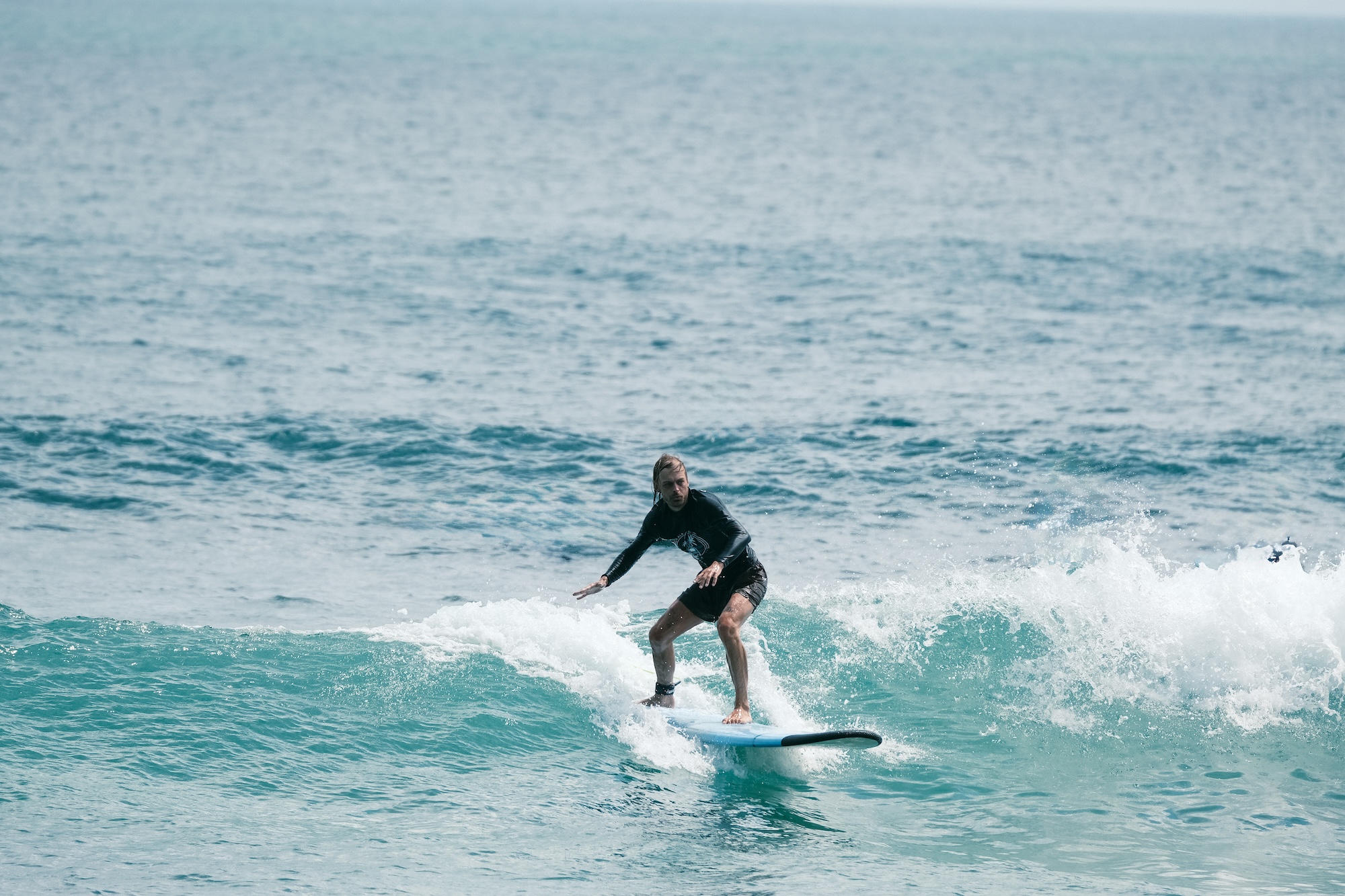
What comes next after you've nailed your pop-up and can go across a green wave?
Backflips? Rotations? Spinny fizzers?
The short answer is none of the above (and especially not spinny fizzers... we made that up). But that's a good thing. You don't need to be launching an air reverse or getting spat out of the tube to be "surfing" for real.
There's a whole ladder of surfing tricks and maneuvers between "I stood up once" and "I ripped that wave to bits" and the bottom few rungs are more fun than they get credit for.
Learn the main maneuvers and you'll go from riding waves to actually milking all the joy outta them.
Below are the main moves worth learning, roughly in the order you'll meet them, plus a quick look up the road at the advanced tricks waiting for you later.
What is a surf maneuver?
A surf maneuver is any deliberate move a surfer makes to control speed and direction on a wave, from basic movements like the pop-up and the bottom turn to challenging maneuvers like the tube ride or a full-rotation air. A few notes on surf maneuvers:
- Pre and beginner surf maneuvers are the foundation
- Master them and the advanced techniques later have somewhere to grow from... no shortcuts
- It also helps to understand where and how waves break. If you can anticipate a section, you can plan what you're going to do on it
- Nearly every maneuver comes down to where you put your body weight, whether your weight is over your front foot or back foot and whether you commit at the right moment. It's the same principle that drives generating speed: heavy and light in the right places at the right time
- Get those habits into your muscle memory during your first Bali trip and you'll be right as rain
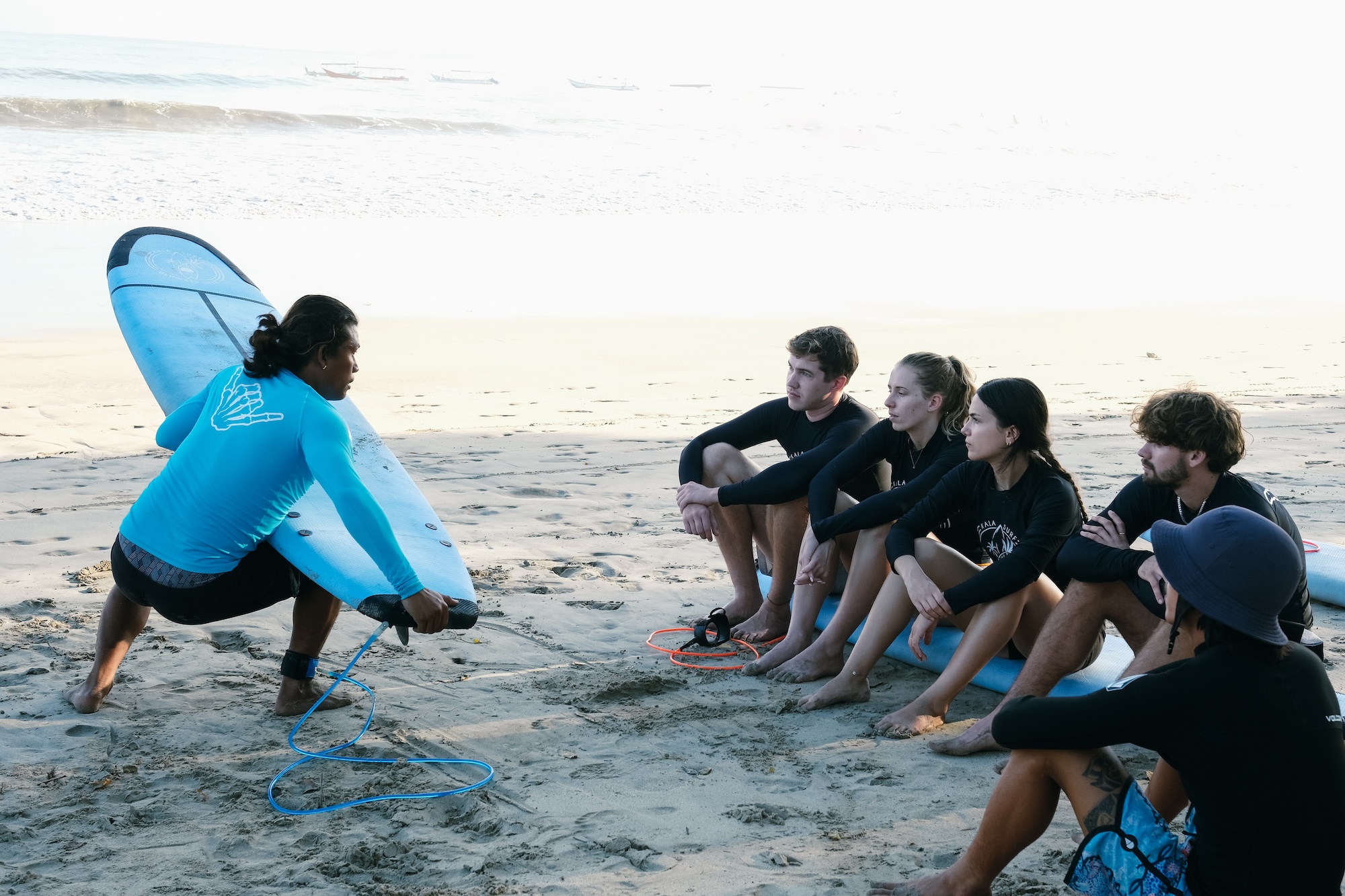
Surfing pre-maneuvers
The stuff that comes before the on-face maneuvers. Just as important. You've got to crawl before you can walk.
The duck dive and turtle roll
Before you can ride waves, you have to get past the ones already breaking. Two moves get you through the incoming waves: the duck dive and the turtle roll.
How to duck dive
For shortboards. You push the nose of the surfboard underwater with your hands, sink the tail with your back foot or knee and slip under the breaking wave as it passes. It looks effortless when the person next to you does it. It is not. Timing the sink, getting deep enough and popping out the back without losing your line all take real practice.
The turtle roll
The beginner-friendly version for bigger boards, also known as turtling. Grab the rails at chest height when lying prone and facing towards the oncoming wave. Roll sideways so you and the board are both inverted. Let the whitewater roll over you before flipping back over. Easier than it sounds and effective once you get the hang of it. Here's a quick video of the turtle roll in action if you're more of a visual learner.
The pop-up and takeoff
Every maneuver is built on these pre-maneuvers, so they're worth mentioning.
How to pop up on a surfboard
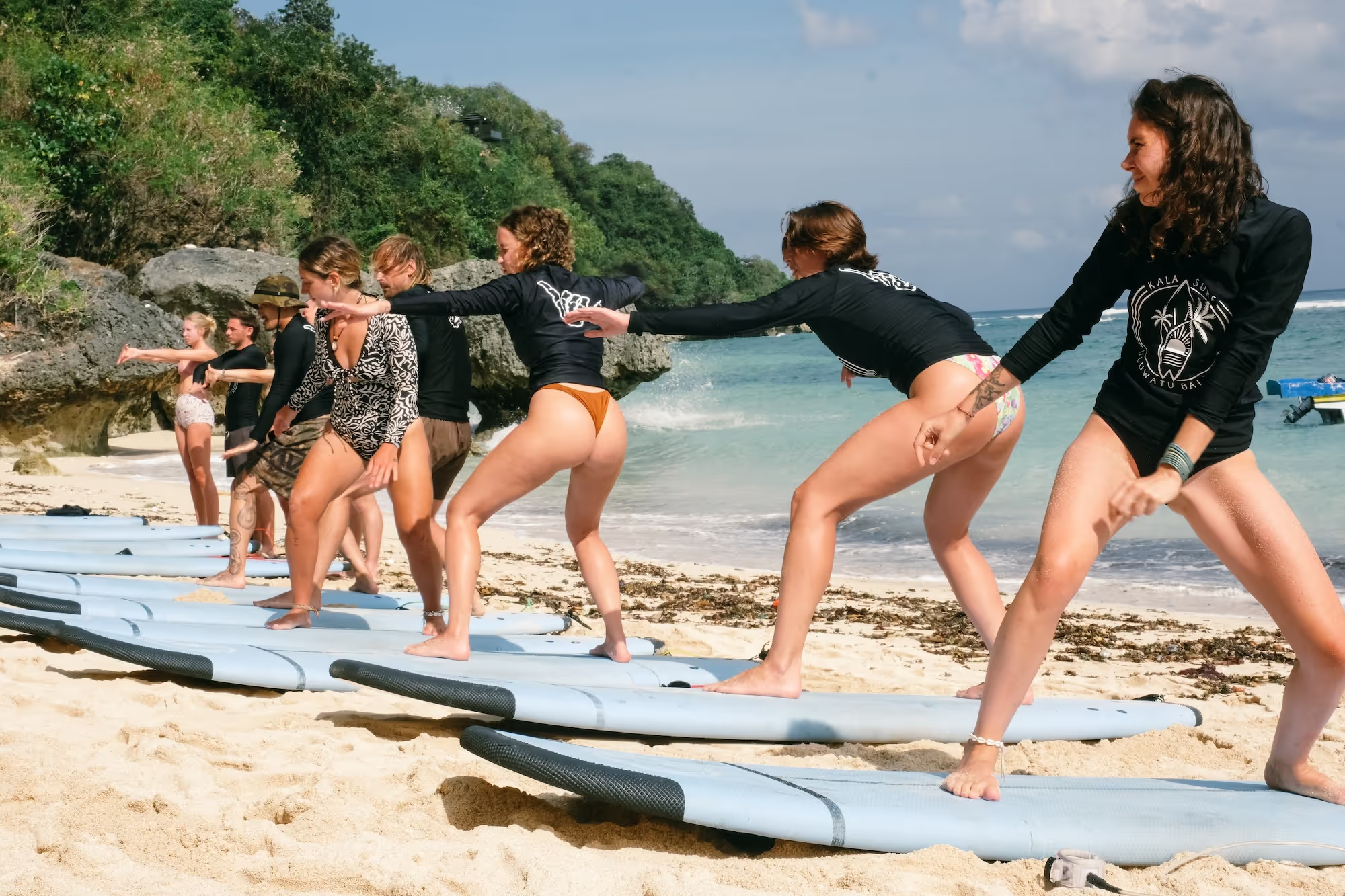
The pop-up is the move that gets you from lying down to a standing position in one clean push. Hands flat under your ribs, push your chest up and swing your feet under your body in a single go, landing with your knees bent and your eyes looking down the line. Drill it on the sand until it's automatic, because a wave gives you less than a second to get it right.
Takeoff
Precise timing on the takeoff, catching the wave at the right moment as it lifts your board, is what turns a nosedive into a successful pop-up and ride.
Note: Most beginner surfers point straight at the beach and ride towards it like a human torpedo. Fun for a while, but a dead end. The next step is angling your take off: instead of dropping straight, you aim along the wave in the direction it's peeling. This small change lets you travel with the wave and change direction along the open face.
Trimming
Once you're catching green (unbroken) waves and standing up, trimming is the first thing that'll actually feel like surfing. If you're not sure which stage you're at yet, our surf levels guide is handy.
Trimming means finding the fast part of the wave face and riding along it, making tiny adjustments to maintain speed. You're not throwing turns yet, you're gliding and reading the wave. The trick is all in your feet:
- Weight on your back foot is your brake. It slows you down
- Weight on your front foot is your gas. It helps you generate speed and drive down the line
Ready to Surf in Bali? Secure Your Spot Now!
Surfing maneuvers
The stuff that comes once you’re on the face of the wave. The fun, showy and highly satisfying stuff, to be exact.
The bottom turn
If you only master one move, make it the bottom turn.
The bottom turn is the turn you make at the base of the wave, right after you take off and drop down the face.
It doesn't look flashy, but many surfers and coaches call it the single most important maneuver in surfing, because it sets up everything else.
- As you drop, you build speed heading toward the bottom
- The bottom turn redirects all that speed back along the wave so you fly out with momentum instead of losing speed at the bottom
- Vertical drop in, horizontal speed out
To do it: as you reach the bottom, bend your knees, load your weight through your back leg, keep some drive in your front leg, press on your inside rail and look where you want to go. The board follows your eyes and your rail.
And when you're learning, draw it out longer than you think you need to. Smooth and wide beats short and twitchy. A rushed, jerky turn fires you straight up the face before you've built anything, and you end up over the lip or bogged in the flats with nothing to show for the drop.
Once that feels natural, the bottom turn stops being a survival move and becomes your speed engine. We've broken down how to use the bottom turn to generate real speed, including the mistake nearly every beginner makes with it, in our speed guide.
The floater
One of the most underappreciated but satisfying maneuvers!
A floater is when you direct your board to the lip or whitewash breaking in a section in front of you and glide (or float) over the top of it.
It's kinda like grinding the coping on a skateboard. The surfing equivalent of hitting a rail in snowboarding.
When done correctly, it'll boost you into the next section. When done poorly, it'll chuck you off the back of the wave or catapult you into the flats. Aim for the former.
Two things make or break it: speed in, and where your eyes go. Hit the section with pace so the board stays light on top of the foam, keep your knees soft, and look at where you want to land, not at your feet. Come off the back of it with your weight slightly forward and you'll ride out clean instead of getting bucked.
An easy way to start trying it: next time a wave closes out in front of you, don't just eject off the back. Ride up to the top of the closeout and float down with the whitewash instead. It's not a real floater, nobody's scoring it, but it's the same feeling with none of the pressure, and it turns a dead wave into a free practice rep.
The cutback/roundhouse cutback
This is usually the first turn that makes people feel like a proper ripper!
Sometimes you build too much speed and race out ahead onto the flat shoulder, the dead part of the wave with no push left. A cutback is the turn that swings you back toward the breaking section, the pocket where all the energy lives, so you don't waste the ride.
Lean into a smooth arc, bring the board around and reconnect with the power by hitting the lip or the whitewash in the breaking part of the wave.
The secret is the same one that runs through this whole article: your board follows your eyes. Turn your head and look back at the whitewash you're trying to get to, let your shoulders follow, and the board comes around almost on its own. Beginners who keep staring down the line keep going down the line.
A trick that was a genuine gamechanger for one of us learning it: use your top hand, the one closer to the wave, and throw it up and back in the direction of the turn. It sounds tiny, but that one arm drags your shoulders around, your hips follow your shoulders, and suddenly the whole rotation happens instead of stalling halfway.
And the roundhouse? That's the full-commitment version: instead of a partial turn back, you draw the arc all the way around in a big figure-eight, rebound off the whitewash and come out facing down the line again. Same move, maximum ambition.
Pretty straightforward in theory, but cutbacks (or cutties) are deceptively hard to master.
You're essentially performing two maneuvers in one: the turn on the face and the rebound off the lip or whitewash. As such, it's difficult to make it look smooth.
More advanced maneuvers
Seen a cool Instagram reel with a surfer smacking the lip, boosting off the end section or getting shacked over a shallow reef? Here's a quick map of the challenging maneuvers that advanced surfers spend years chasing:
- Carve: Burying the rail to change direction in one powerful, drawn-out arc. The cutback you just learned about is actually the first member of this family
- Snap: A sharp, radical change of direction off the top that throws those flashy buckets of spray. Barrels aside, it's probably the most violent and satisfying trick in surfing: done right, you shoot a fan of water into the air and everyone on the beach knows about it
- Off-the-lip: A vertical hit where you drive off the wave's lip on a steep slope and bust the fins out of the wave
- Barrel ride (the tube): The ultimate surfing maneuver. Riding inside the hollow part of the wave, fully covered by the lip, and coming out the other end. It's the greatest, most critical place a surfer can be
- Airs and rotations: The surfer spins and flips above the wave's surface. This family includes the air reverse, plus expert-only moves like the rodeo flip, the kerrupt flip and the flynnstone flip... each its own flavour of rotation, named after the surfer mad enough to land it first
FAQs
Q. What is the first surf maneuver a beginner should learn?
After a solid pop-up and takeoff, focus on trimming (riding along the wave face with speed) and then the bottom turn. The bottom turn is the foundation every other maneuver is built on.
Q. What are the main surf maneuvers in order of difficulty?
Roughly: pop-up, trimming, angling the takeoff, bottom turn, cutback and roundhouse cutback, floater, carving turns, snap and off-the-lip. Then, advanced tricks like the barrel ride and airs such as the air reverse, rodeo flip, kerrupt flip and flynnstone flip.
Q. What's the difference between a cutback and a carve?
A cutback is a type of carve, the one that turns you back toward the breaking part of the wave when you've run out onto the flat shoulder. Carving is the broader family: any turn where you bury the rail and change direction in one drawn-out arc. Master the cutback and you've started carving.
Q. How long until I can do turns on a wave?
If you're surfing regularly and catching green waves, basic trimming and changing direction come within a few sessions. A rough bottom turn and cutback follow over the next few weeks. Consistency beats raw talent every time.
Q. Do I need small waves or big waves to practise?
Small, clean waves are perfect for learning most beginner surf maneuvers because they give you time and forgiveness while you build muscle memory. Even closeouts are useful: riding up and floating down the whitewash is free practice for floaters. Save the bigger, more challenging waves for once your basic movements are dialled.
Q. Will surf lessons actually speed this up?
Massively. Most of these maneuvers come down to timing and where you put your weight, which is nearly impossible to self-diagnose mid-wave. A coach watching from the channel catches the one thing holding you back, often in a single session, and that's exactly what a surf camp is built for.
Ready to level up your surfing in Bali?
Nothing fast-tracks this like daily surf lessons on quality waves with a coach watching your every move. And surprise, surprise... that's what we're all about.
Come stay with us in Uluwatu and here's the honest promise: pop-up drilled on the sand, first angled takeoffs, a real bottom turn by the time you leave, and the skate bowl to work your turns between sessions. The tricks further up the ladder can wait. The ladder starts here.
More blogs you might like

FAQs
Find answers to your last-minute questions about your upcoming surf adventure with us.
Our packages include accommodation, daily surf lessons, and access to all camp facilities. We also provide surf gear for your convenience. Additional activities can be booked separately.
Travel insurance is highly recommended to cover any unexpected events. It can protect you against cancellations, medical emergencies, and lost belongings. Please check with your provider for specific coverage.
Booking is simple! Visit our Packages & Prices page to select your desired package. You can complete your reservation online or contact us for assistance.
Kala Surf Camp is located in the heart of Bali, close to the best surf spots. Our camp offers a peaceful environment while being just a short distance from vibrant local culture. You'll enjoy easy access to both surf and relaxation.
Yes, date changes can be made depending on availability. Please contact our support team as soon as possible to discuss your options. We aim to accommodate your needs whenever we can.