


How to Generate Speed While Surfing and Surf Faster


You know the feeling. You're up and riding. The wave's peeling ahead of you. But instead of ripping or gliding down the line, you get caught behind.
The section rifles off down the line, your board loses speed and boom... ride over.
Here's what almost every improving surfer eventually realises: once you're on the wave, speed doesn't come from paddling. It comes from what you do with your body and your board. Where you take off, where you sit on the face, and when you're heavy versus light on your feet. All of it is learnable, and none of it requires stronger arms.
Below is how to generate speed surfing, starting with where it actually comes from.
What actually makes a surfboard go fast?
Two things: the wave's momentum and the board's design.
The wave is the freebie. When your board drops down a steep part of the wave, you accelerate. Kinda like rolling down a hill on a bike. The steeper the drop or open face of the wave, the more speed you get. And like the bike, the hill doesn't pedal for you. Everything in this article is really about one thing: finding the steep part of the wave and staying on it.
Your board's design is the other engine. We've done a great breakdown on the basics of board design, but essentially a surfboard perfectly suited to your size and ability will help you build speed, not bog you down. More rail in the water and more surface area means more glide with less effort, which is why board choice matters most when the waves are small and weak.
Technique tips for getting more speed when surfing
Start in the right spot: positioning at takeoff
- Speed creation starts before you're even on your feet
- The fastest place to take off is the peak, the steepest and highest point of the wave
- Drop in there and gravity immediately hands you speed to carry down the line
- Take off on the soft shoulder and you start with nothing in the tank
- Our advice? Back yourself and sit a touch deeper
Here's the thing we see constantly: plenty of surfers know all this and still sit on the shoulder, because the peak feels intimidating and the shoulder keeps you out of the spotlight. It's understandable, and it works against you. Out there you're trying to catch the wave at its weakest point, and even when you do get one, you've given yourself the shortest ride on offer. You're setting yourself up to fail and then wondering why you're not progressing.
So back yourself and sit at the peak. And when your wave comes, be committed and GO FOR IT. Nobody in the lineup cares if you wipe out. At least you went.
Once you're up, aim down the line, not straight at the beach. Riding straight to shore is the number one reason beginner surfers lose speed. Of course, this'll inevitably happen when you're starting out. But as you progress, you can angle your takeoff, perform a bottom turn and use the whole face of the wave.
The bottom turn: converting the drop into speed down the line
The bottom turn is how you cash in the speed the drop just gave you. Done right, nothing is faster on a wave. Done late or lazy, all that free speed drains into the flats and you're back to square one.
What our coaches see beginners do, over and over, is the opposite problem: turns that are too short. A quick half-turn off the bottom, a token top turn, and then a long stretch of riding the middle of the wave, where there's no gravity helping you and the speed bleeds away.
If the wave gives you time, do the opposite. Draw the bottom turn out long, drive up the face as high as you can get, then drop back down and do it again. Bottom to top and back, using the full height of the wave. The middle is where speed goes to die.
The move itself:
- Ride down the face and, as you reach the bottom of the wave, bend your knees and lean onto your toe rail (frontside) or heel rail (backside)
- Look where you want to go, along the line of the wave, not at the beach. Your board follows your eyes and shoulders
- Let the turn redirect everything the drop gave you so you come out of it travelling along the wave instead of away from it
- The steeper the drop, the harder you can lean into it. On a soft wave, keep the turn shallow so you don't scrub off what little speed there is
Think of it as the hinge between two of the tips in this section. Takeoff position gives you the speed, the bottom turn points it somewhere useful, and the pocket keeps it topped up.
A surfer once put it to me in two parts: a good turn generates speed, and the less of your board touching the water, the faster you go. Those sound like separate thoughts but they're the same one. When you're properly on rail through a turn, most of the board is out of the water, so there's less dragging against you. That's why a committed turn comes out faster than it went in, and a flat, tentative one just scrubs.
Stay near the pocket (the power source)
Burn this one into your brain, peeps!
- The power in a wave lives in the pocket, the steep part near the breaking lip, in the top third of the wave face
- Ever notice how more experienced surfers are always cutting back towards the breaking part? That's because they're trying to stay near the pocket
- That's where power and drive are strongest
- Drift onto the flat shoulder and there's no push left, so you slow and sink, sit too low near the whitewater and it's just as dead
If you're newer to this, build the habit of looking back over your shoulder mid-ride to check how far you've drifted from the breaking part. The pocket doesn't chase you. And don't let your own speed fire you out onto the flats, because then you're stuck doing the Huntington hop, bouncing the board around out there trying to make speed from nothing, until the whitewater catches up and slams into you.
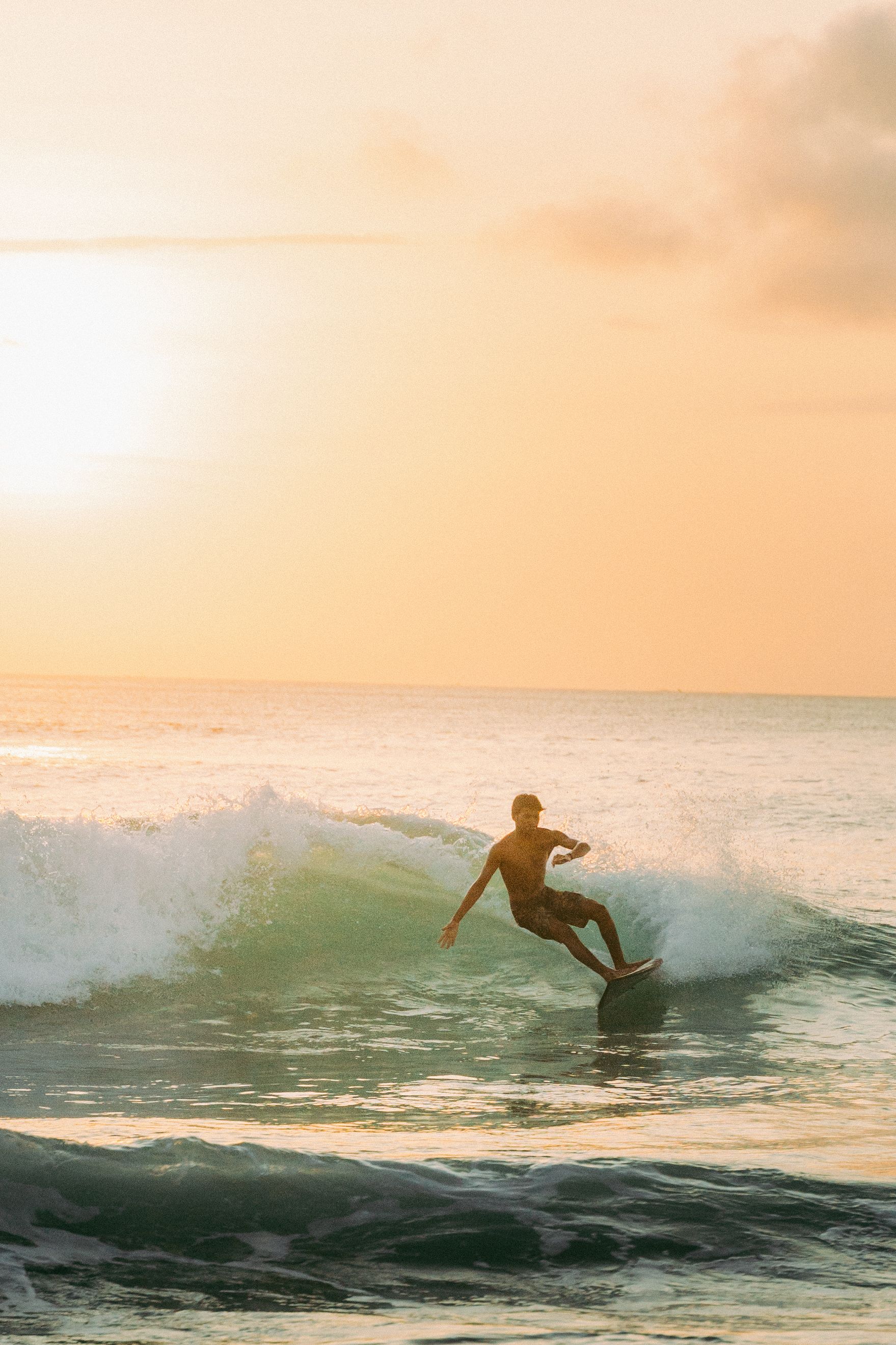
Pumping... a sneaky way to generate speed
Watch good surfing and you'll notice that the board is rarely static.
- Skilled surfers ride up toward the lip and back down the face, staying in the top two-thirds and out of the dead flats
- That up-and-down movement, done in one smooth flowing motion, is pumping... the bread and butter of speed on a shortboard
- Heavy going down, light coming up
The secret sauce is timing your weight. Two moves, repeated:
- Compress on the way down: As the board drops down the face, get heavy. Bend your knees and press your chest toward your front knee so gravity loads up. This is where you gain speed
- Decompress on the way up: As you climb back up the face, get light. Extend your legs, stand tall and use your arms and eyes to direct where you want to go
The best place to learn this timing isn't even in the water. It's on a surf skate, where you can drill compress-decompress over and over without waiting for a wave. We've got a surf skate bowl at Kala, and you can set up a surf skate lesson with us. The movement translates straight over to surfing and pays off fast.
When the wave goes fat and there's no real face to pump, the same move just gets smaller and scrappier: quicker, shallower pumps to skip across the flat section until the wave stands up again. It won't look pretty. It keeps you moving. Small wet season days are perfect for practising it.
Ready to Surf in Bali? Secure Your Spot Now!
The most common ways surfers lose speed
If you keep running out of gas, you're probably doing one of these:
- Riding straight to the beach instead of angling down the line
- Outrunning the wave onto the flat, powerless shoulder and having to look back over your shoulder to find it again
- Sitting too low near the whitewater
- Stalling with too much pressure on the tail
- Digging a rail and catching an edge
- Flailing and wiggling instead of moving smoothly. Pumping is one flowing movement, not a shimmy. If your shoulders are doing the work, the board isn't
- Taking off on the shoulder to stay out of the spotlight, then wondering why every ride is short and slow
Does your equipment matter?
Absolutely.
Bigger, more buoyant boards like longboards have more rail in the water, so they gain and hold speed easily, often just by trimming across the face. That's why they're friendlier for beginners.
It's also why the fix for constantly getting caught behind is sometimes not technique at all. If you're always half a beat late, think about jumping up a size. More volume means you paddle in earlier, get to your feet with the wave still ahead of you, and carry speed you didn't have to make. A bigger board might not look as cool. It works anyway.
You see this at G-Land. The old local boys out there ride huge boards, and it's not nostalgia. It's so they can get into the wave early and safely, and carry enough speed to make it through the critical sections.
Shortboards have less rail and surface area, so trimming alone won't keep up with a fast wave, which is why pumping matters. If speed feels hard right now, it might partly be the equipment, not just you.
FAQs
Q. How do surfers go fast without paddling?
Once you're on a wave, speed comes from gravity and rail engagement, not paddling. You drop down the steepest section of the wave to accelerate, then use your rails and a pumping motion up and down the wave face to keep that momentum going.
Q. What is pumping in surfing?
Pumping is riding up and down the face of the wave in a smooth, flowing motion to build speed. You compress (get heavy, bend your knees) on the way down to load up gravity and decompress (extend, stand tall, throw your arms) on the way up. It's the main way surfers generate speed on smaller boards and waves.
Q. Why do I keep losing speed on a wave?
Usually because you've drifted away from the pocket, the most powerful part of the wave. Riding onto the flat shoulder, sitting too low near the whitewater, going straight to the beach or stalling with too much tail pressure all bleed speed. Stay high, near the steep breaking part of the wave.
Q. How do I generate speed on small or weak waves?
Take off deep at the peak, stay close to the pocket and use quick, shallow pumps to skip across the flat sections until the wave stands up again. A bigger, floatier board also helps massively on mushy waves.
Q. What is a bottom turn and why does it matter for speed?
The bottom turn is the turn you make at the base of the wave after the drop, leaning onto your rail to redirect straight-down speed into speed along the wave face. It matters because the drop is where gravity hands you free speed, and the bottom turn is what stops that speed draining into the flats. A committed turn on rail comes out faster than it went in.
Q. Is speed generation hard to learn?
The concept is simple: use the wave's energy and the right board. The hard part is timing, and that's easier to drill on land than in the lineup. A few sessions on a surf skate with a coach watching your compress and decompress beats months of guessing in the water.
Ready to actually feel this on a wave?
Reading about pumping only gets you so far. Nothing beats a coach in the water calling out your timing on a real wave. Which is exactly what we do. And between sessions, the skate bowl is right there for drilling the timing until it's automatic.
Come surf with us in Uluwatu, where the Bukit has everything from mellow waves to build your pumping skills to long spicy walls to open it up.
More blogs you might like

FAQs
Find answers to your last-minute questions about your upcoming surf adventure with us.
Our packages include accommodation, daily surf lessons, and access to all camp facilities. We also provide surf gear for your convenience. Additional activities can be booked separately.
Travel insurance is highly recommended to cover any unexpected events. It can protect you against cancellations, medical emergencies, and lost belongings. Please check with your provider for specific coverage.
Booking is simple! Visit our Packages & Prices page to select your desired package. You can complete your reservation online or contact us for assistance.
Kala Surf Camp is located in the heart of Bali, close to the best surf spots. Our camp offers a peaceful environment while being just a short distance from vibrant local culture. You'll enjoy easy access to both surf and relaxation.
Yes, date changes can be made depending on availability. Please contact our support team as soon as possible to discuss your options. We aim to accommodate your needs whenever we can.